



Right after college, I began meeting weekly with my friend Stephen to discuss the books we were reading. I had just graduated with a degree in international business, but I had spent more time reading literature than coursework material. I read Crime & Punishment, Moby Dick, The Scarlet Letter, and others. And I read them for fun.
My friend Stephen has studied literature at the undergraduate, graduate, and PhD levels. I envied his course of study. I remember enthusiastically asking him what he thought about Moby Dick, absolutely certain he had read it with that level of formal education.
He sorrowfully answered that he had not read Moby Dick. I was shocked. He went on to explain that he had read all about Moby Dick, the background of the author, and the cultural context of the novel, but his program of study had not required the reading of the actual novel. He got so burned out that he quit his PhD program midstream. By the time we started meeting, he was on a quest to make up for his lack of education.
That was 20+ years ago, but I think about Stephen often. While there is merit in learning about how to approach a novel, how to learn about the author and context, that pales in comparison to reading the actual novel. I was reminded of Stephen when I saw this article last week in The Wall Street Journal.
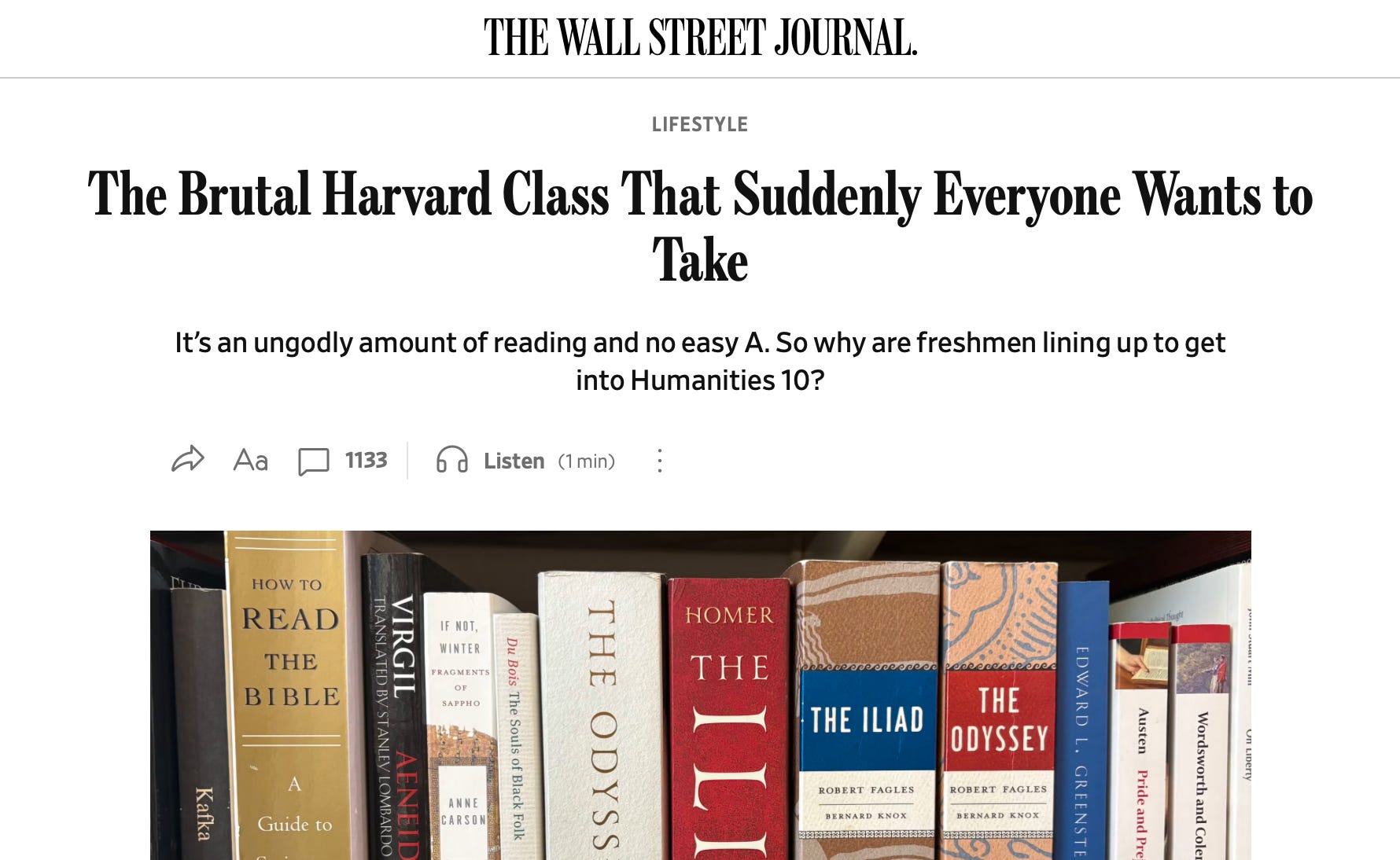
I quipped on X that:


The article itself is rather short and lighthearted in tone. It starts with this:
Those who see the humanities, heavy coursework and value of a Harvard education as gravely imperiled can take heart in the phenomenon that is Humanities 10.
I certainly did not take heart with what followed. Pamela Paul, the author of the article, describes how Harvard now offers an “old school” course requiring students to read a book a week. This course had to be “dreamed up over dinner in 2008” by “renowned” Harvard professors as a way to “combat plummeting student interest in the humanities.” It’s one of the most damning commentaries on Harvard that I can imagine.
The university that produced the great Harvard Classics book series and Loeb Classical Library Greek and Latin texts had to be reminded that a canon of the Great Books exists where students can encounter the most exceptional minds of the past? Oops, I just used two words that are conspicuously absent from the course description: “Great Books” and “canon.”
Do you remember when you’d get into trouble as a child and your parent would say they weren’t angry, but that they were sad? Somehow, that would be infinitely worse. That’s my emotion when I read this article. It’s not anger, it’s a deep sadness. How does an elite university get to the point where “It’s a fever that even the professors are struggling to explain?” How does an entire university system educate my friend Stephen on the periphery of the novel but not actually read the novel itself, the very thing he sought to do through his field of study?
There is a deep hunger to read the greatest works written across the ages. First of all, I see it in myself. The key focus of this reading project is to read the books I really should have read in school.
Secondly, I see it in others. Just last night, I led my monthly in-person reading group covering Short Great Books. When I asked if the attendees wanted to continue into the new year, they all enthusiastically agreed. Nearly every member of the group was reading Jason and the Argonauts for the very first time for last evening’s discussion. One new member, the manager of a local Publix supermarket, said he was simply looking for a group where he could discuss great literature. None of his friends were reading books like this.
I see it when people come into Landmark Booksellers and plant themselves in front of The Great Wall, a collection of the greatest works ever written (containing a healthy collection of books published by Harvard University).
We want to be challenged by the best minds and the best books. For some reason, parts of the educational system, even the elite parts, seem to have forgotten this. In the meantime, the mantle is being carried by others. There’s a groundswell of interest, where individuals are finding other individuals to read and discuss literature. They are doing this in small groups around the world, through podcasts like Ascend, in online communities like The Catherine Project, and in college settings like St. John’s, Ralston College, and others.
It turns out that you don’t need a university education to approach the Great Books. It might help along the way, but it actually might harm, like it did Stephen. You can just start reading these works on your own or with others. These books were not written to confuse you.
While Harvard continues to be shocked and awed at the freshmen students lining up for this challenging course, pick up a Great Book from the canon and nourish your soul.
Applicable to all sorts of literature, I think… From a minister’s perspective, the tendency is to speak about the Bible without actually preaching it. Moreover, in terms of books, the challenge is quite helpful. I did participate in a program where we actually read the Great Books. I would only add that having someone from a Christian worldview skilled in the ideas of those books is invaluable to enjoying them more. R.C. Sproul did this with philosophy; made me like poems like the Raven, and books like Moby Dick even more…. also in terms of philosophy, he gave a keen sense of appreciation while offering astute critiques in his Consequences of Ideas.