


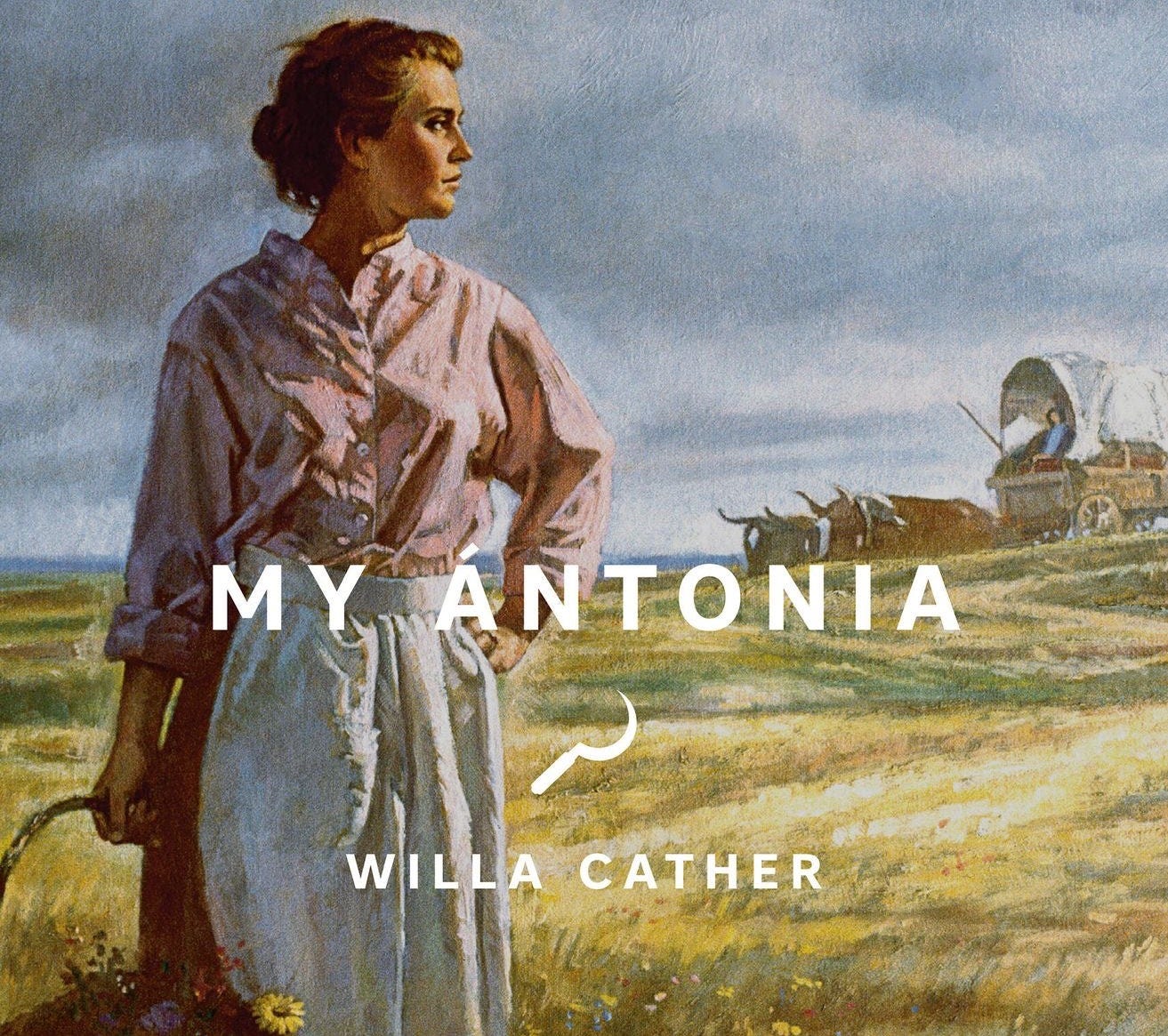
I lead a monthly reading group at Landmark Booksellers called Short Great Books. For September, we discussed My Ántonia by Willa Cather. It’s a story set in the plains of Nebraska and it’s a nostalgic look at life in 1880s through the lives of immigrant families from Bohemia, Norway, Austria, and Russia. We get to know their fears, hopes, and struggles.
The story is presented as an account by Jim Burden, an orphan sent to live with his grandparents who live in Nebraska. Upon arrival, he meets Ántonia, a newcomer from Bohemia, and a few years his senior. Jim is writing his account later in life, so he’s looking back at his memories of his time in Nebraska in of his vivacious friend Ántonia.
Ántonia embraces her new life and the challenges that come with it. Her father doesn’t fare as well. He was well-respected in his Bohemian hometown and he finds the Nebraska farming life unnatural and difficult. He takes his own life with a gun on a cold bed.
Later in the novel, Ántonia lays down on a bed and takes a different path. “There, without calling to anybody, without a groan, she lay down on the bed and bore her child.” A bed of suicide for her father becomes a bed of life for Ántonia. She goes on to bear 10 more children.
I wonder if part of Jim’s account is an exploration of why he didn’t pursue Ántonia romantically. He’s in an unhappy marriage when we meet him as an adult. As a youth, he struggles to know what he wants. Ántonia is the opposite. She has a strong sense of self. Deep down, she knows what she likes and doesn’t like. Later in life, Jim says of her “Antonia had not lost the fire of life.”
I really like this novel. I first read it after Christmas in December 2001 and for a second time in preparation for this latest reading group. It’s one of those books that stirs up memories and nostalgia. I found myself getting lost in my own memories. The book reminded me of Theo of Golden, yet I can’t quite put my finger on the reason why.
I also thought a lot about the experience of my forebears, Norwegians and Germans who settled in Wisconsin in the 1800s. I wondered if their experiences matched those in this book. I tried to imagine the heartbreak of leaving a homeland, the struggle to start from scratch, and the experiences forging a new path.
There are a few fantastic lines in this book:
“I was entirely happy. Perhaps we feel like that when we die and become a part of something entire, whether it is sun and air, or goodness and knowledge. At any rate, this is happiness; to be dissolved into something complete and great.”
The older I get, the more I relate to this line about specific people in my past:
“…some of the figures of my old life seemed to be waiting for me in the new.”
“Aint it wonderful, Jim, how much people can mean to each other?”
Ántonia loved life, people, and even trees (this is what she said about trees):
“I love them as if they were people”
Willa Cather is on my Great Authors list and so I will be reading her again in the future. I look forward to reading My Ántonia for a third time and reading Cather’s other works. It’s a special thing for a novel to open up your own past as you get lost in its story.
If you live in Franklin, join us for the final three reading group meetings for the year. Or, feel free to read along on your own if you’d like some book suggestions. Here’s what’s on tap for the rest of 2026:
Candide - Voltaire
Jason and the Argonauts - Apollonius
The Nutcracker and the Mouse King - E.T.A. Hoffmann