


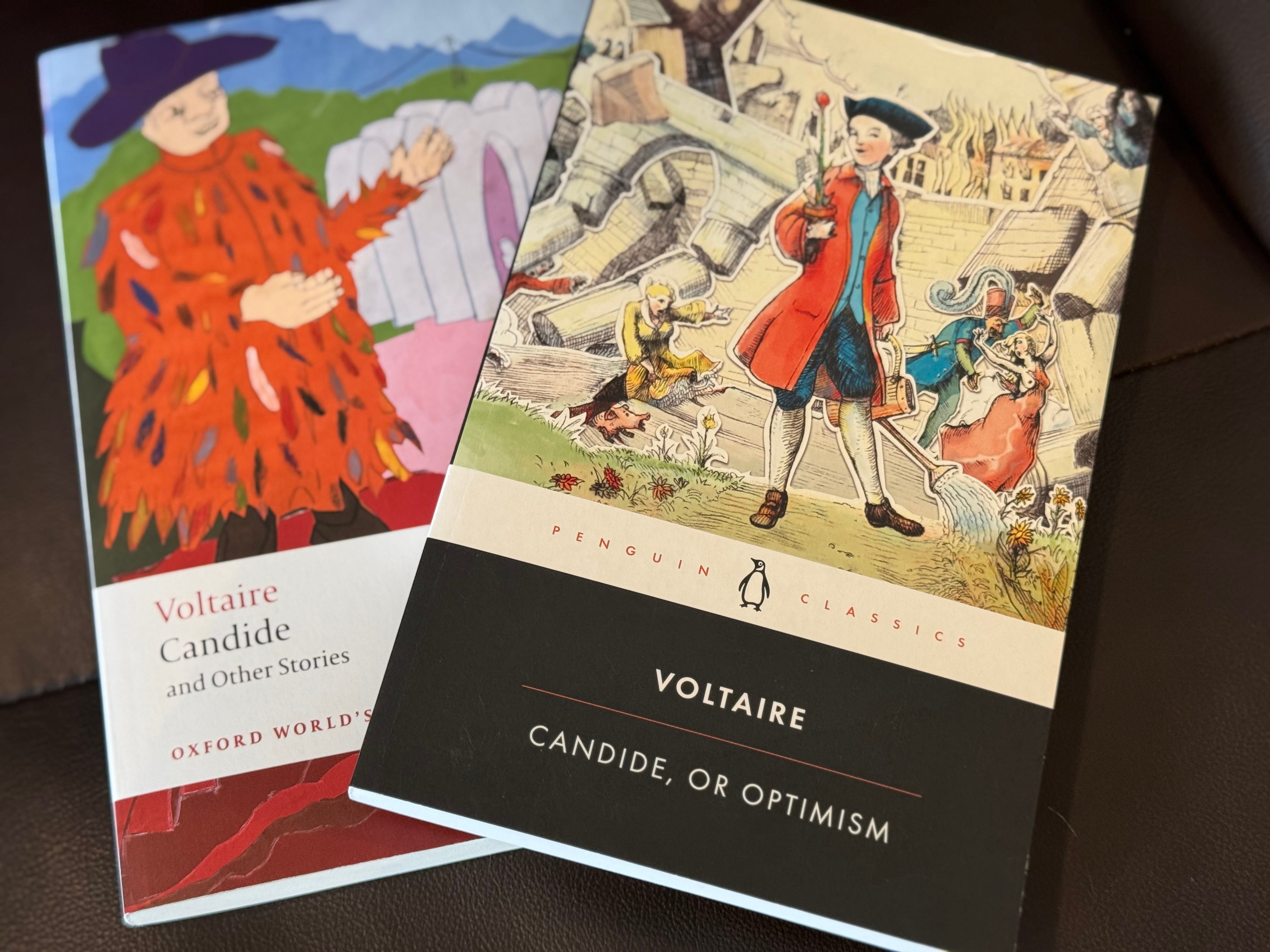
I just read Candide by Voltaire for my Short Great Books reading group. As I shared last week, Candide is “an absolutely lovely tale of ‘rape, pillage, murder, massacre, butchery, religious intolerance and abuse, torture, hanging, storm, shipwreck, earth-quake, disease, prostitution.’”
It’s a satire where despite these horrors, Voltaire keeps you cackling with delight. This satire was a response to philosophical ideas, worldviews, and an utterly devastating earthquake. Here’s the genesis of the story:
1710: Leibniz’s Optimism
The subtitle for Candide is “Optimism.” Voltaire was referring directly to the work of Gottfried Wilhelm Leibniz who said this world created by God is the best of all possible worlds. The ramifications are that everything happens for a reason, that there is a certain inability to change what will happen, and that “all is well.” This is known as Leibniz’ optimism. (While reading, I found myself considering how often I respond to situations with “It’s all good.”)
1755: Lisbon Earthquake
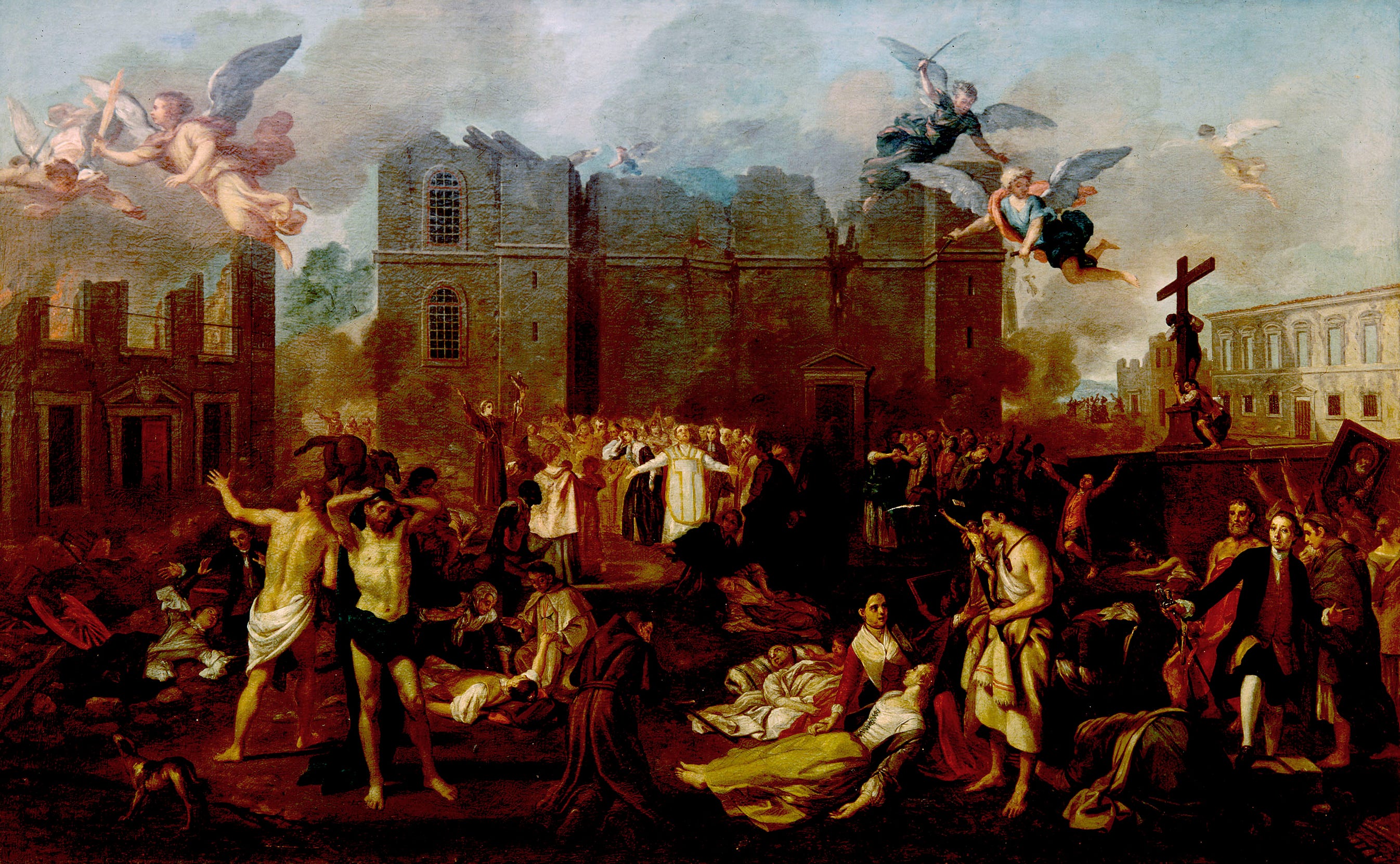

On November 1, 1755, 40,000 to 60,000 people were killed by an earthquake that struck the Portuguese capitol of Lisbon. Though in Geneva at the time, Voltaire was deeply impacted by this catastrophe and began to question the idea that “all is well.” Can this be the best possible world if this level of devastation can occur?
1756: Voltaire’s Poem
Voltaire responded to this tragedy in 1756 with a poem entitled “Poem on the Lisbon Disaster” where he questioned Leibniz’s ideas:
Come, ye philosophers, who cry, “All’s well,”
And contemplate this ruin of a world.
Behold these shreds and cinders of your race,
This child and mother heaped in common wreck,
These scattered limbs beneath the marble shafts—
A hundred thousand whom the earth devours,
Who, torn and bloody, palpitating yet,
Entombed beneath their hospitable roofs,
In racking torment end their stricken lives.
To those expiring murmurs of distress,
To that appalling spectacle of woe,
Will ye reply: “You do but illustrate
The iron laws that chain the will of God”?1
1756: Rousseau’s Letter
In August 1756, Jean-Jacques Rousseau responded to Voltaire’s poem with a letter in which he defended optimism and divine providence by stating that mankind was at fault. He said that people were not meant to live so closely together in packed cities but were instead meant to live in more rural, natural settings. Had the Portuguese been living that way, the death toll from the earthquake would not have been as high. Don’t blame God; blame people.
1759: Publication of Candide
Voltaire’s response to the philosophy of Leibniz and Rousseau was to write Candide, a short work of satire. In Candide, we follow a protagonist aptly named Candide. The name itself conjures ideas of innocence and an openness to ideas. Candide is heavily influenced by the optimistic philosophy of Pangloss, who despite circumstances, continually reassures Candide that “All is Well.”
In the subsequent pages, we’re met with unspeakable atrocities and Pangloss’ continual view that “All is Well.” Through the countless horrific occurrences, we see Voltaire testing optimism against reality.
I found the medium that Voltaire chose, satire, to be a very interesting choice. He could have simply written a philosophical treatise in response to Leibniz and Rousseau, but it would not have had the impact of this memorable story. He also could have responded by letter to Rousseau, but he chose a style with ties to Cervantes and Aristophanes. Voltaire was likely working around speech restrictions in this choice, but it was smart move and he blanketed the major markets with copies before it could be properly censored (though that didn’t stop the Roman Catholic Church from adding it to its Index of Forbidden Books in 1762).
The conclusion of Candide was a pleasant surprise. Satire by definition is critical, yet that spirit departs in the final Qohelet-like admonishment to tend one’s garden. Biblical references abound throughout the story with close connections to the Garden of Eden, the expulsions from Eden, and the lost sheep.
Books come from books. That is a central observation from this reading project. That’s why I’m reading the Great Books in chronological order. I want to see how ideas have been stated, refuted, altered, and considered across time. In Candide, we see a microcosm of the great conversation with Voltaire grappling with ideas that came before him and experiences that left him shaken. The result is a work considered to be one of the key texts of the Enlightenment.
Hey Eric! Will you continue the Short Great Books next year?
I loved Candide! You’re right, that satire was far and away a better vehicle than another essay to respond to Rousseau’s jackleg opinion. But it’s difficult, so that makes it a dangerous choice, unless you execute really well like Voltaire. Makes me want to pick it back up.