


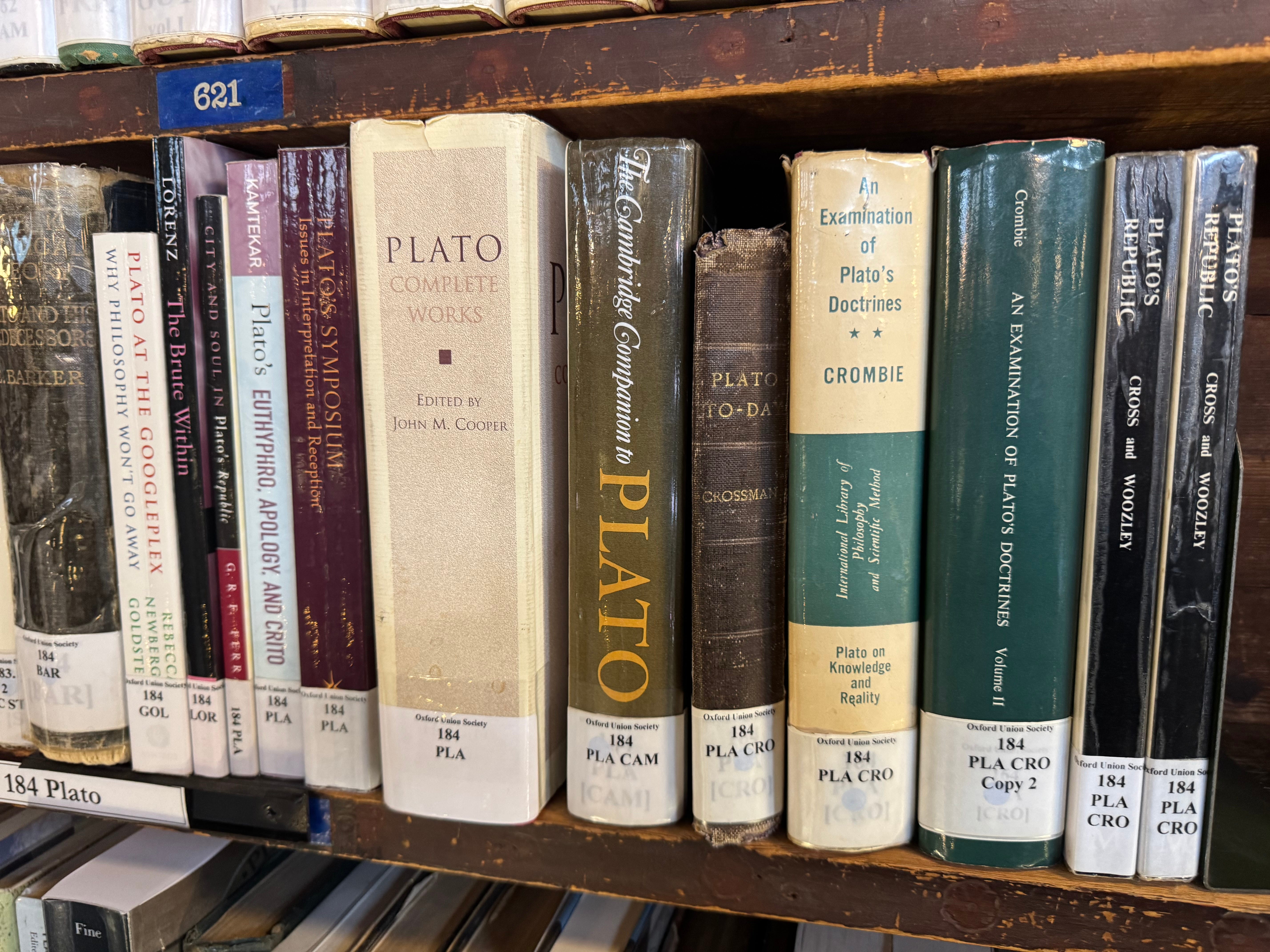
What comes to your mind when you think about studying philosophy? I’m immediately taken back to the fall of 1999 and my Intro to Philosophy (Phil 1000) course at the University of Georgia. I was way out of my league. I couldn’t even keep up with an introductory course. I somehow earned a B grade but left frustrated at my inability to understand what I was reading. I did not continue on to Phil 2000.
I carried that frustration and a healthy bit of fear into this reading project when I started reading Plato last year. I struggle with his dialogues. I require multiple readings just to grasp the main ideas. Plato’s Parmenides dialogue nearly broke my brain.
Perhaps I’m not doing philosophy the right way. There’s something that has stood out in Plato’s works. Part of it is explicit and the other part is the nature of dialogues. The explicit part is that Plato has Socrates state that philosophy is best done person to person. The nature of the dialogues show philosophy occurring between people.
That may seem like a fairly inane observation, but my assumption going into this was that philosophy was best done individually in front of a book. That the true philosopher was alone, turning ideas in his or her head. That may be part of it, but Plato’s ideal certainly does not look like that. And it also doesn’t look like a teacher in front of a 40-student Phil 1000 course.
There’s an interesting story that Plato has Socrates tell in the Phaedrus dialogue about the Egyptian god Theuth talking to Thamous, the king of Egypt. Theuth is known as the inventor of “number, arithmetic, geometry, and astronomy, of games involving draughts and dice—and especially of writing.” Thamous surprises Theuth by saying that his invention of writing will “atrophy people’s memories.”
He goes on to say:
“Trust in writing will make them remember things by relying on marks made by others, from outside themselves, not on their own inner resources, and so writing will make the things they have learnt disappear from their minds.”
Many critics have pointed out that Plato has Socrates relay this story in a written dialogue. Ironic, yes. But he continues:
“It’s the same with written words: you might think they were speaking as if they had some intelligence, but if you want an explanation of any of the things they’re saying and you ask them about it, they just go on and on for ever giving the same single piece of information.”
Written words don’t have the organic nature of a conversation. They can’t explain. They can’t answer. The original Greek of Plato’s dialogues has not changed in the past 2,400 years. The lone philosopher in front of a book is missing something.
Over the past year, I’d estimate my time breakdown as 99% reading Plato and 1% discussing Plato with others. That’s not Plato’s ideal. Perhaps the better approach would be to spend more of that time in conversation about these dialogues, preferably with a teacher.
I wish I would have given Phil 1000 more of my attention during college when I could have spoken with the professor. I’m doing this Great Books project outside of a university or group. I’m doing it alone. And as I’m reading Plato alone, he keeps telling me to do it with others.
Maybe you should start a philosophy group like Lewis’s Inklings. Funny about writing making our brains atrophy. I love note taking as I read. I like to think that I am mapping things out that are written long form in a more accessible way, complete with bullet points, arrows, even a sketch here or there. And my hope is, of course, in spending the time with the text and the physical process of hand writing the words, that my brain will be more likely to remember it.
It reminded me superstition of reading gravestones causes forgetfulness in Istanbul. Then I found Cicero talking about it too: “…nor have I any fear of losing my memory by reading tombstones…”. And in history some scholars rely only memory and burn their notebooks to not let others learn anything incorrectly. Many other cases like that…
Now, I can add my Memory vs. Writing list another quote from your essay “…his invention of writing will “atrophy people’s memories.” 😄