


While The Odyssey is about to hit movie theaters around the world, in Ancient Greece, rhapsodes would travel and perform recitations of Homer’s epic poems to large audiences. Rhapsodes were a mix of actor and lecturer. They wouldn’t just perform the epics but would also explain what the poets meant in their stories. Whether they did the explaining through their acting or through side speeches is unclear.
In Plato’s dialogue titled Ion, we meet the rhapsode named Ion. Socrates approaches Ion to ask him about his profession and to tease out his specific skill set. A rhapsode is competition for the philosopher. Ion, in passing down the epics of the past, is also passing down traditional views of the gods and morality. Socrates wants to influence the morality of the populace through reasoned argument, not through the emotions. In The Republic, Plato actually wishes to banish such imitative poets from his ideal city for their negative, diversionary influence.
This dialogue beings with Ion having just won first prize in a poetry contest. He has brought tears and laughter to 20,000 audience members and has won the accolades of the masses. We learn quickly that Ion has a singular focus on Homer and cares nothing for other poets. Socrates uses this as a way to examine the skills that Ion possesses.
Socrates (Plato’s mouthpiece) uses a particular manner of examination in this dialogue. We see him use it elsewhere and it’s a process derived from the early Greek philosophers, who were attempting to find the First Principle, the archē of things (for example, Democritus’ first principle(s) were atoms and void). In the Plato dialogues Statesman and Sophist, Socrates uses a method of definition through division. Socrates is seeking the core elements, the first principles of those professions. He’s atomizing the concepts to reach the root.
We see him employing a similar tactic in Ion. He’s conducting a proxy war of sorts against Homer through his “acting” agent Ion. So, while Socrates is questioning Ion specifically and the profession of the rhapsode more generally, his ultimate target is Homer. If he can show that the rhapsode is not skilled, he can draw a line back to Homer and show how philosophy is the better way.
Socrates references a series of episodes from the Iliad and the Odyssey and asks Ion who would be more skilled to talk about things like charioteering and divination, him or an expert. Ion admits that an expert would be more skilled.
This is where the dialogue becomes tricky. If a rhapsode is explaining the epic through dramatization, Socrates’ series of questions are absurd. Can you imagine Ion stopping in the middle of a scene to call in the expert charioteer to lecture on the intricacies of horses? It would destroy the show. The majority of the 20,000 attendees would get up from their seats and leave.
Ion gets tricked in this dialogue. Socrates actually makes him look absurd and unskilled through definition by division. There are two instances where Socrates asks Ion point blank what skills he has over and above the experts in the field. In both cases, Ion responds by saying “in everything.” This was not the answer Socrates was expecting.
I think Ion was right. He was more skilled in Homer as a whole. He should have responded to Socrates by reciting the episode of Priam kissing the hand of the man who killed his son from the Iliad. He should have then asked Socrates the question, who judges this better, the rhapsode or the expert in kissing hands? The rhapsode or the anger management counselor? The rhapsode or the parent who has lost a child?
Ion was right because you can’t atomize the arts. You can’t break Homer down into small pieces and determine if he was as correct as an expert about a given topic. “The play’s the thing…” as Shakespeare stated through Hamlet. You don’t combat Homer by breaking him down. You combat Homer by telling better stories. Ion was correct - he was better at understanding and portraying the epic that has lasted 2,500+ years.
Plato knew this. He was a tragedy playwright himself (the story goes that he burned them all upon meeting Socrates). He utilized dialogues and myths to tell what he considered to be better stories. While it seems as though Ion is the absurd man in this dialogue (and he does say some absurd things), I actually think Plato presents Socrates as the absurd one for his line of questioning. Ion’s double response of “everything” exposes a deep insight about the arts.
Plato also uses this dialogue to explore the origin of these arts. Do they arrive through the skill of the artist, through the possession of the poet by a god, or through some middle ground of divine inspiration?
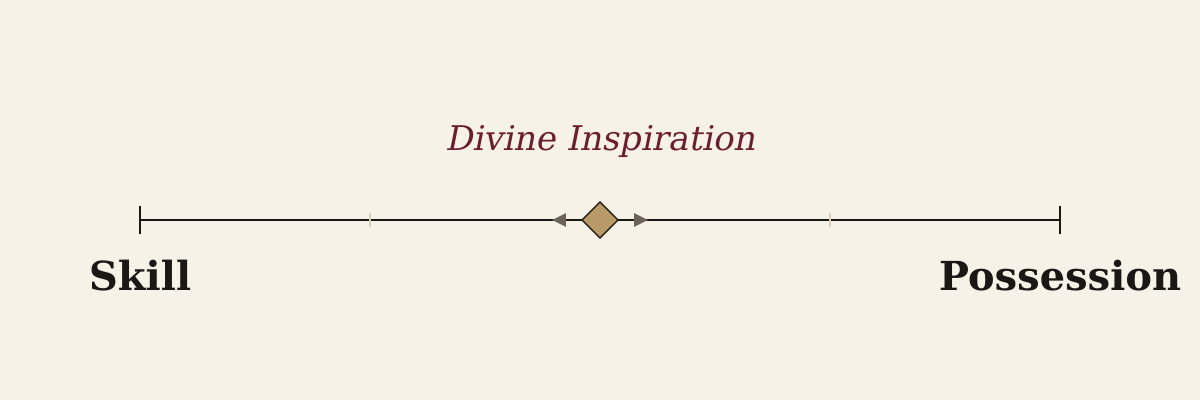
When I talk to artists, I rarely hear them say that the song, painting, or poem came through their own skill. They are skilled at what they do, but that’s not the origin. And I’ve never heard someone say they were completely out of control and possessed during the creation process. Nearly every time, I hear the artist admit that the work of art flowed through them in a way that they can’t fully explain. They were in control but something outside of their control happened in the process.
How do you atomize a work of art like that? How do you atomize Homer? You can’t. Ion was right.