


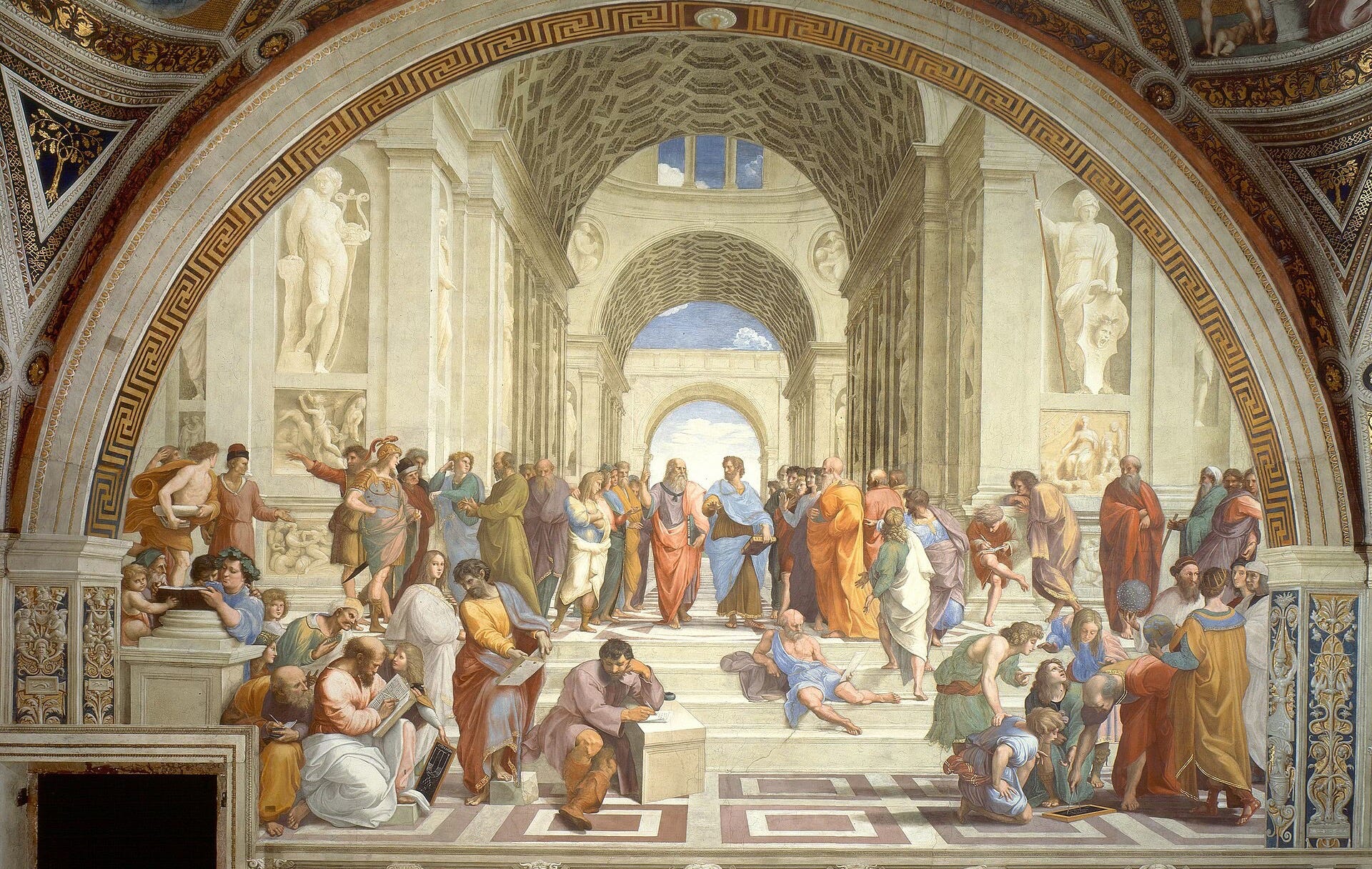
My family and I were in Rome, Italy a few weeks ago and visited the Vatican Museum. We were herded past priceless works of art on a tight timeframe with the end goal of seeing the Sistine Chapel. Right before the beloved chapel, I entered the room that contained Raphael’s School of Athens.
I’ve long admired this painting. I bought a print of it some 25 years ago and usually have it visible in my office. I’ve known that these were the men who set the philosophical tradition in order, but I never knew who each person was in the painting.
Raphael’s painting takes up an entire wall at in the Apostolic Palace at the Vatican. It was completed between 1509 - 1511 AD and it is wondrous. I stayed in the room as long as I could.
I’m in the midst of reading through the early Greek philosophers. Some of them are depicted in this painting. As I’ve been reading about them, I’ve been making a note of who appears in the painting. Here are a few of those I’ve been reading about who are depicted in the painting:
Plato & Aristotle
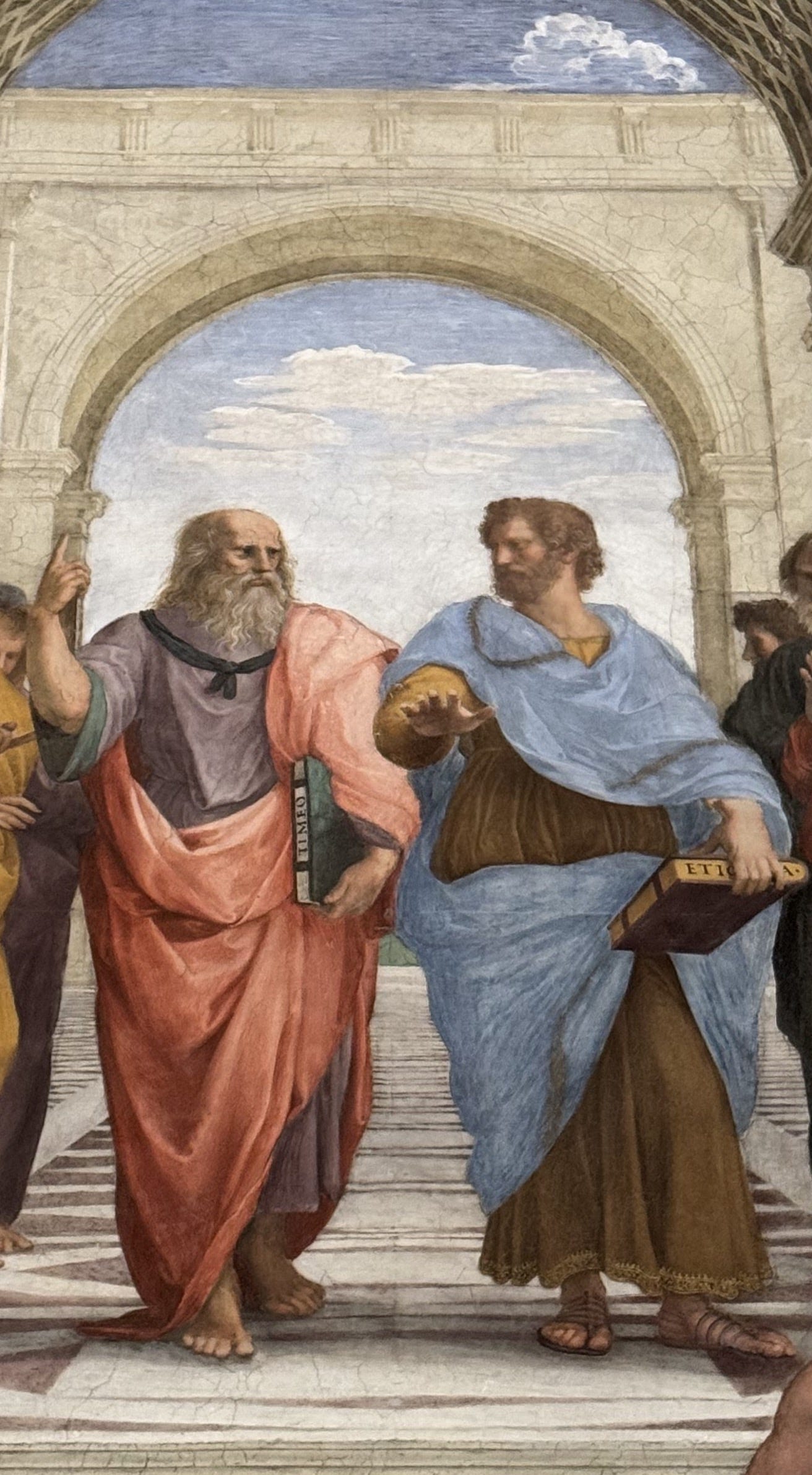
Plato and Aristotle are the focal point of the entire painting. Plato is in red on the left and Aristotle in blue on the right. There are some really neat things to observe in each philosopher:
Raphael painted Leonardo da Vinci (1452 – 1519) as Plato.
Plato is pointing up to the heavens, to the unchanging Forms
Aristotle is gesturing to the earth, focusing on observable reality
Plato is holding his work Timaeus
Aristotle is holding his work Ethics
Heraclitus
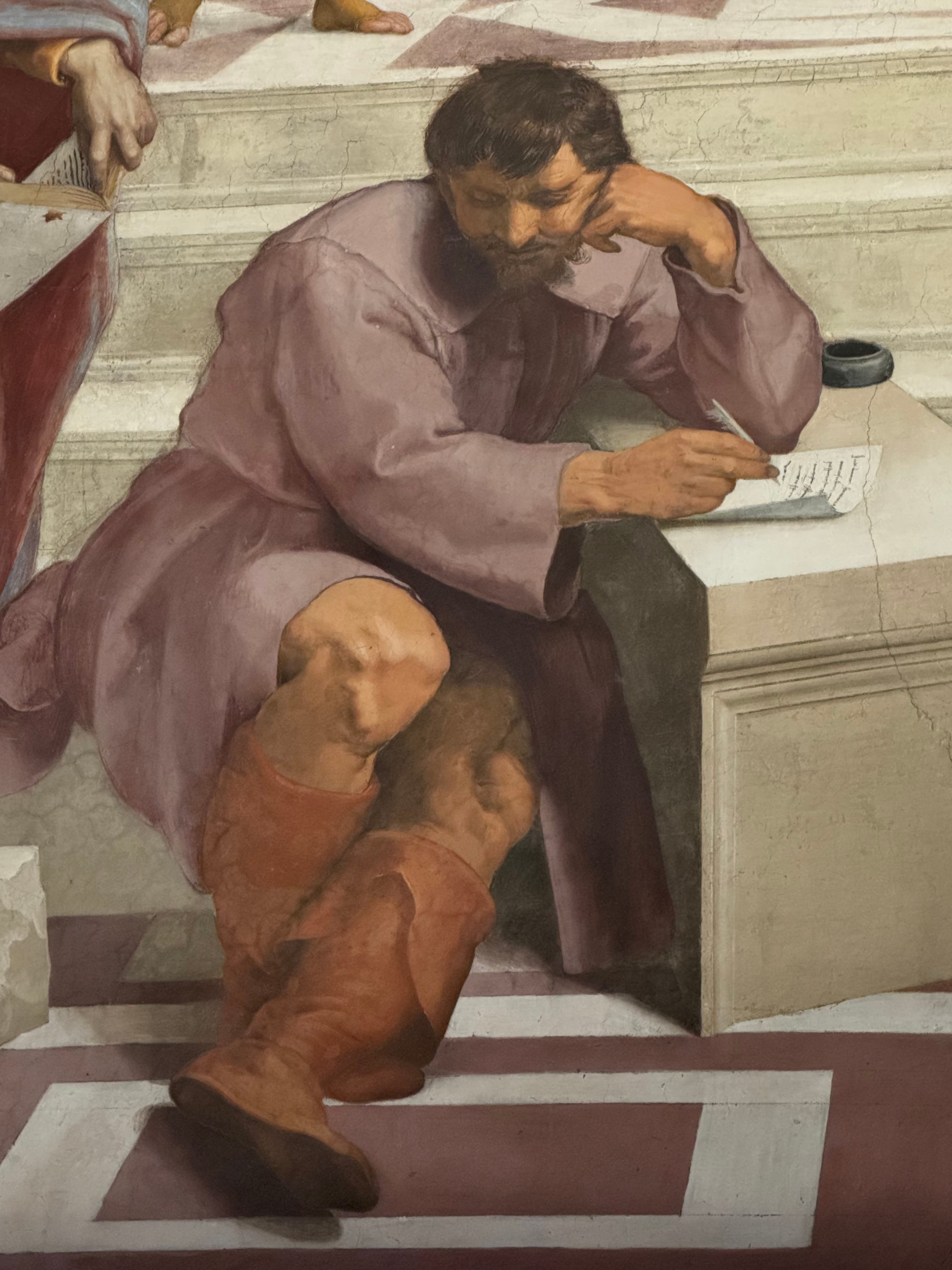
Heraclitus (535–475 BC) is seated front, slightly left of center. He’s alone. He was known as Heraclitus the obscure and could be quite dismissive of his colleagues. He wasn’t a pleasant guy to be around. Yet his ideas of logos, fire, and flux set a philosophical path we still discuss today. Raphael painted the ninja turtle artist Michelangelo as Heraclitus.
Socrates
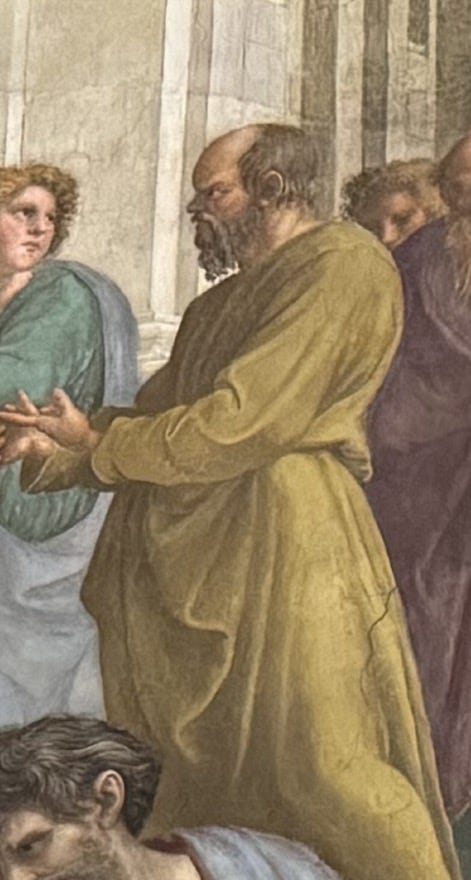
I’m actually surprised that Socrates is not closer to Plato and in a more prominent place. Although, perhaps it is appropriate that he is in discussion rather than holding a book like many of the others. He did not leave written work behind. Plato did that for him.
Parmenides
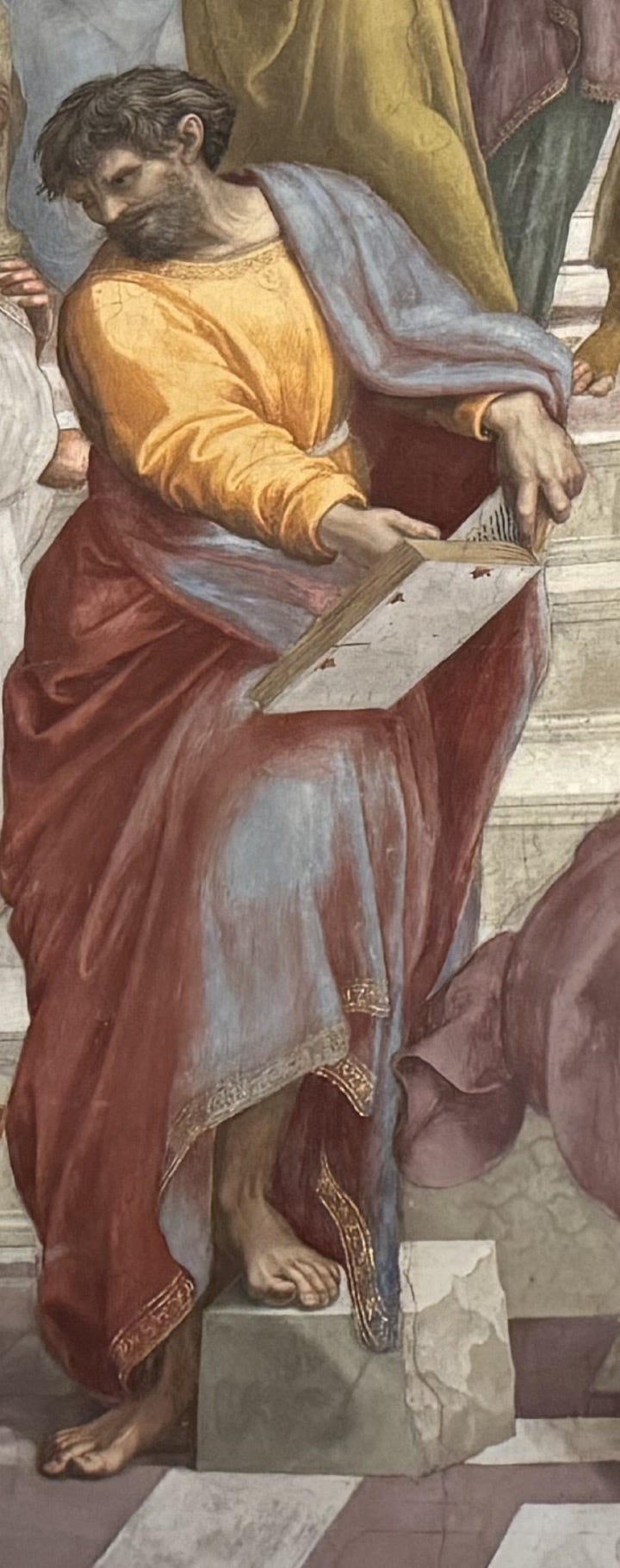
Parmenides led me to the early Greek philosophers, albeit in a roundabout way. I read Plato’s dialogue called Parmenides and was completely and utterly confused. I realized I needed to stop reading Plato and go back to the philosophers whose ideas Plato was referring to. That led me on the trail of learning about these early Greek philosophers.
Parmenides lived from 515–445 BC. Most of the early Greek philosophers have a first principle or fundamental element. For Parmenides, his first principle was Being. He believed that things that didn’t exist could not even be discussed. Perhaps that’s why he’s standing on a solid stone to signify the firm foundation of Being. The book he is holding is likely On Nature, his main work.
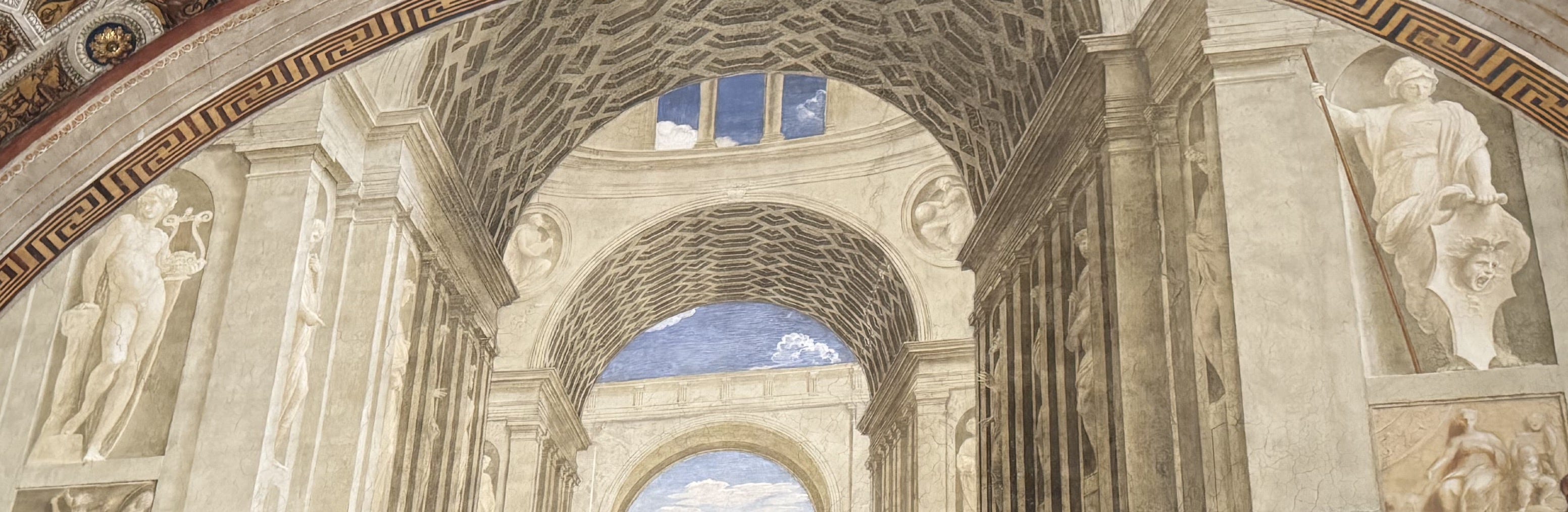
Towards the top of the painting, two Greek gods flank the artwork. Apollo is on the left and Athena on the right. The architecture is similar to what you see inside St. Peter’s Basilica at the Vatican.
My plan is to continue to identify the philosophers in the painting as I learn about them.