


In my conversation last week with Malcolm Guite, he identified three subject matters the medieval poets considered worthy of epic poetry:
The Matter of Troy
The Matter of Gaul
The Matter of Britain
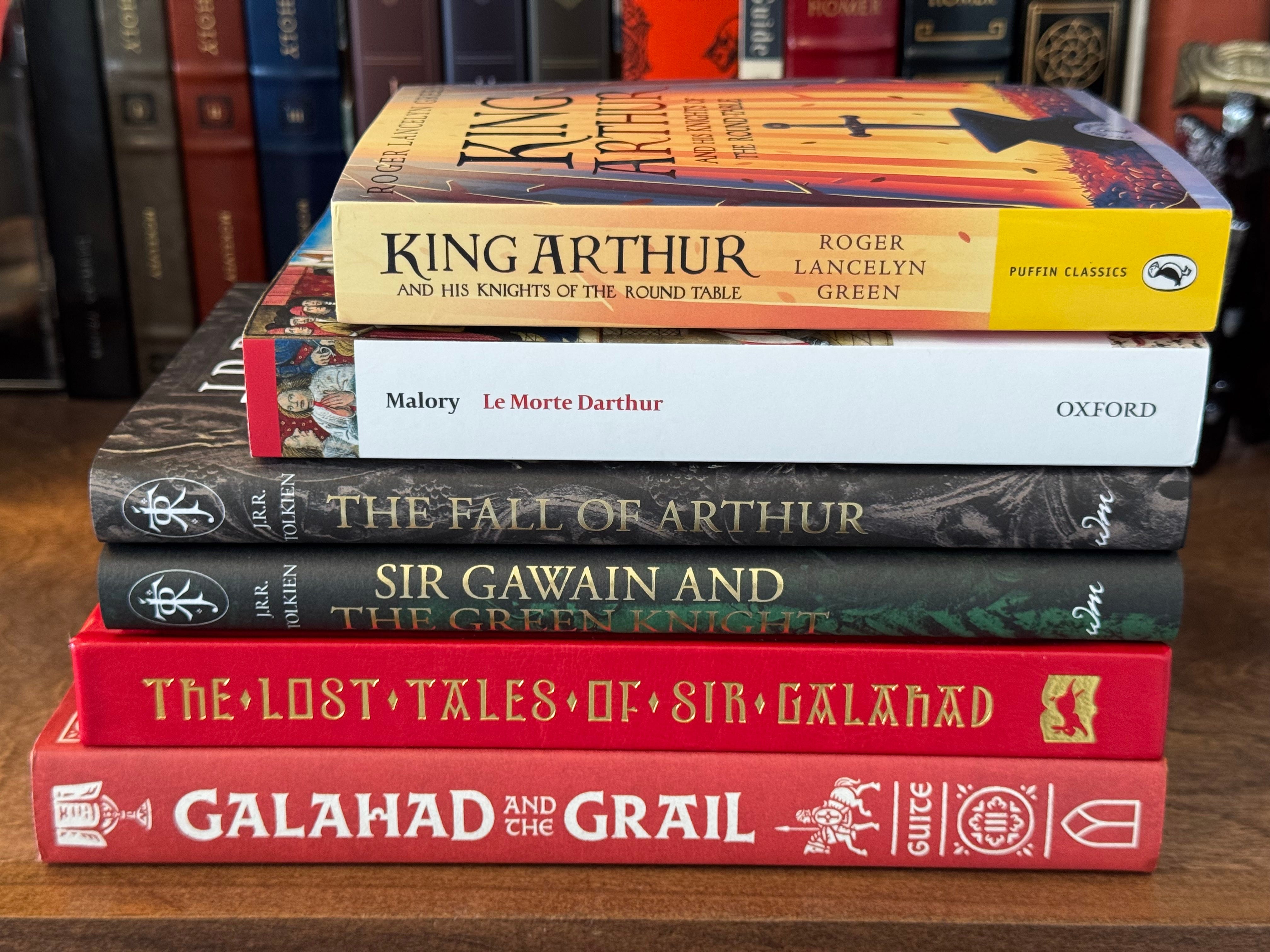
I’ve dedicated my reading for June 2026 to The Matter of Britain, which consists of the legends of King Arthur. Except through brief encounters through movies, this is my first foray into these tales. I’ve been learning about Arthur through Sir Thomas Malory, Roger Lancelyn Green, and Malcolm Guite.
I’ve had an epiphany these past two weeks as I’ve been enjoying the tales of Arthur. I’m currently reading through The Great Books. I never realized how many of these classic works make use of The Matters as their subject matter.
For example, the tales of Arthur are taken up in the following works and by these authors from my Immortal Authors reading list:
The Mabinogion (#67) — the earliest Welsh Arthurian tales
Sir Gawain and the Green Knight (#82) — the finest Middle English Arthurian romance
Edmund Spenser, The Faerie Queene (#98) — Prince Arthur as questing hero
Alfred Tennyson, Idylls of the King (#162) — the Victorian retelling of the whole cycle
Mark Twain, A Connecticut Yankee in King Arthur’s Court (#168) — the satirical inversion
Additionally, many of The Inklings, including C.S. Lewis, J.R.R. Tolkien, Charles Williams, and Owen Barfield, wove these tales throughout their works. Lewis drew on the Arthur theme in That Hideous Strength, and Tolkien translated Sir Gawain and the Green Knight and embarked upon The Fall of Arthur.
As Malcolm Guite pointed out last week, there is no authorized version of the tales of King Arthur. There’s no definitive account on my list of Great Books. Geoffrey Monmouth, Chrétien de Troyes, Robert de Boron, and Sir Thomas Malory collected the tales through their works over the ages, but there’s not one original Arthuriad source we can point to. Like Homer, they took the oral tradition and set it to writing.
My epiphany is that these Matters intersect many of the Great Books and it’s important to have a proper familiarity with these stories.
The Matter of Troy permeates the Great Books. There are two main lines, two epic cycles from which Homer’s epic poems, the Greek Tragedians, and later authors pull from. These are the Theban and Trojan epic cycles. The Iliad and the Odyssey are part of the Trojan epic cycle. The Aeneid is also included in the Matter of Troy as Aeneas survives and escapes from Troy to found Rome, thus connecting Troy to Rome. (There’s a neat legendary connection between Troy and London that Malcolm Guite highlights in last week’s episode).
For the Matter of Gaul (France), also known as the Carolingian cycle, these three works of heroic deeds emerged between the late 11th and early 12th centuries:
Chanson de Guillaume
The Song of Roland
Gormont et Isembart
The Song of Roland is on my Great Books reading list. Later authors like Boiardo with Orlando Innamorato and Ariosto with Orlando Furioso continued the tale.
I’ve been enthralled with the tales of Arthur that I’ve been reading for the first time over these past two weeks. They’ve quickened my imagination and it’s been amazing to see how many of the world’s greatest authors were also taken in by these tales. As you read through the Great Books, make sure you incorporate these Matters and these stories into your reading. You’ll see traces in your favorite books, movies, and music.
On a more personal note, my grandfather was a scholar and he named my mother Enid, who was the wife of one of the knights of the round table, Sir Geraint, from Tennyson.
For a good source of information at King Arthur and his knights, you can also watch the movie musical Camelot. It focusses on Arthur, Guinevere, and Lancelot.