

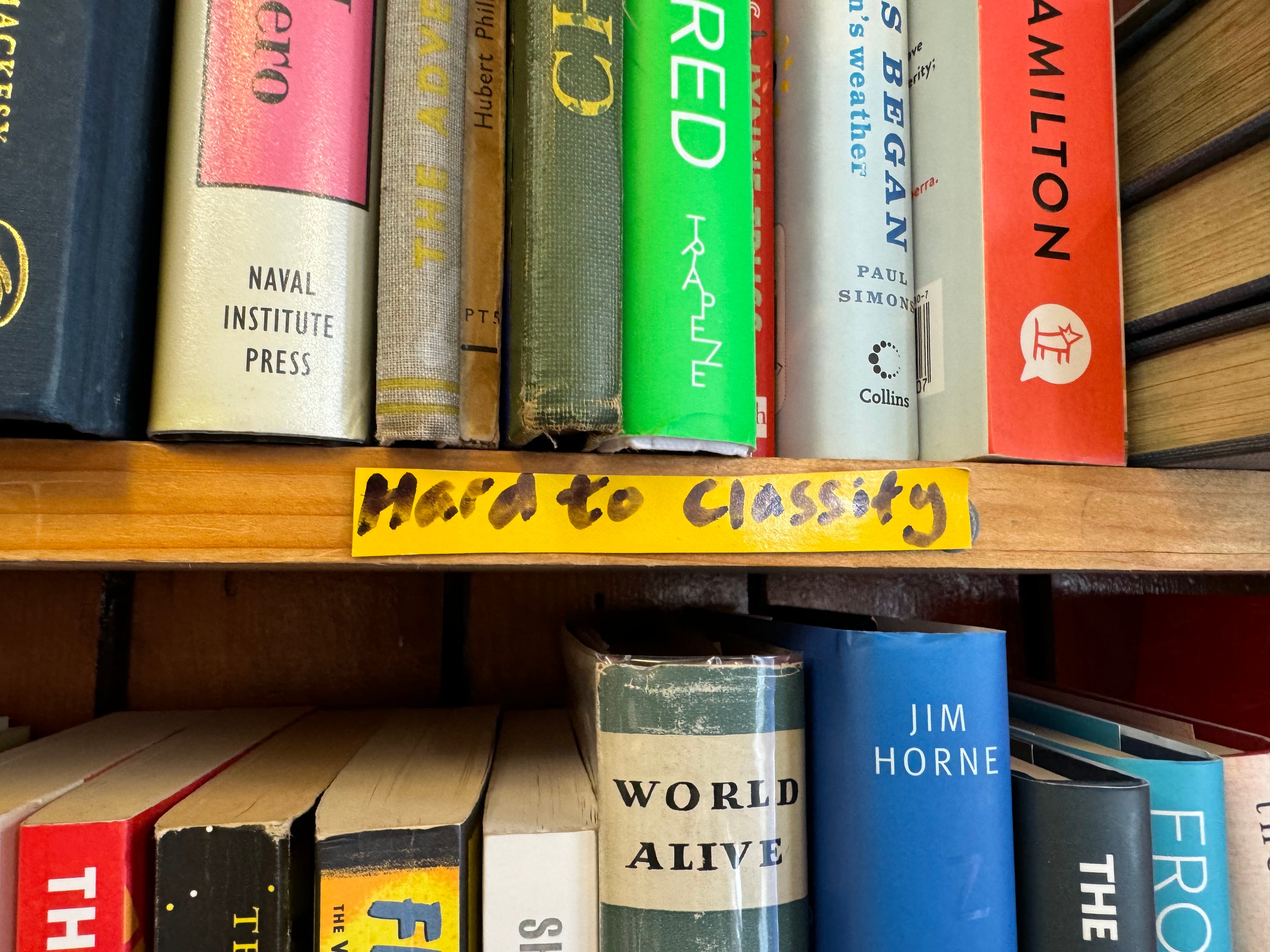
One reason I love visiting bookstores is to see how they organize their wares. A few years ago, I came across this delightful “Hard to Classify” section of books at Edinburgh Books in, you guessed it, Edinburgh. It’s the catch-all folder in your inbox. The “other” section that’s usually hidden away. The place where the high ideal of perfect organization meets messy reality.
Some books are just too hard to classify.
But hard to classify sections end up creating exciting connections in our brains. What fascinates me about bookshelves like this is that books usually placed far away from one another are paired based upon the whim of the bookseller. Many bookstores are experimenting with unique organization methods:
I spoke to an author last year who is getting ready to open a bookstore organized around the seven deadly sins. The books would be arranged by topic of the main sin therein.
At Ryan Holiday’s Painted Porch, he has purposefully curated inventory to only carry books he, his wife, or his staff have personally read.
At Landmark Booksellers, we’ve introduced The Great Wall, a presentation of 200 or so of The Great Books presented in chronological order. We’re also considering a new section of books organized by illustrator. Imagine seeing a shelf of books illustrated by N. C. Wyeth, Barry Moser, or Stephen Crotts.
I organize my own shelves in chronological order, which not only helps me to remember what I read, but also pairs books together that would typically be topically arranged.
I find that the order in which I read books helps me to make connections I would normally miss. The proximity of ideas stick out in ways I simply wouldn’t remember with more time between the books. In a similar way, the ordering and organization of books helps expose me to books I might miss when classified by topic.
Here’s to more “Hard to Classify” sections.