


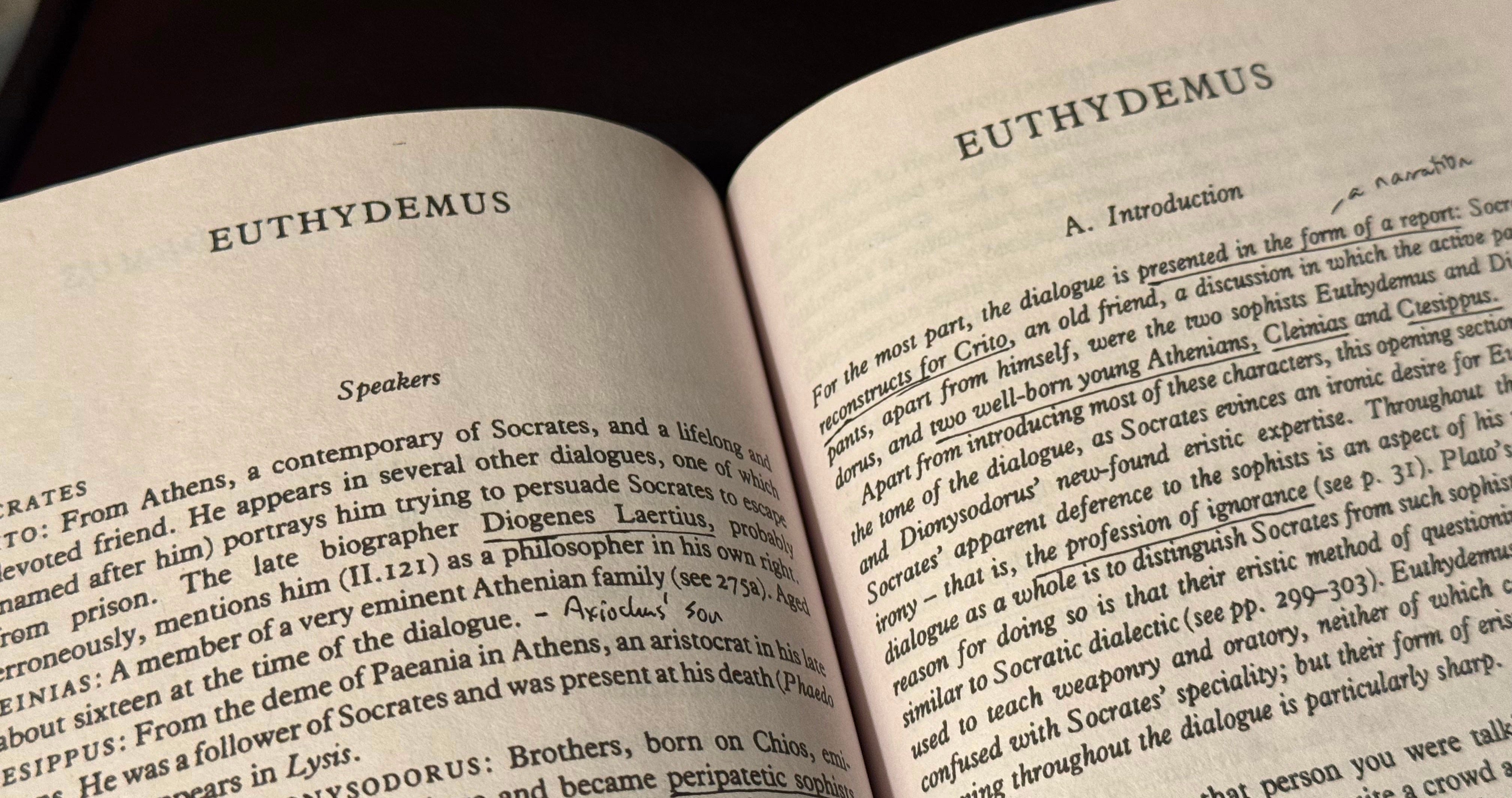
I’ve just finished reading Euthydemus, my 23rd Plato dialogue. I started my Plato Project attempt to read the philosopher’s complete works in August of 2025. I have 12 dialogues remaining. It’s been a challenging but deeply interesting journey into philosophy.
In the Euthydemus dialogue, Plato pits two Sophists, Euthydemus and Dionysodorus against Socrates to show different paths to wisdom and virtue. At a simplified, high level, Sophists seek victory, to win the argument whether it’s true or not, and the philosophers seek truth above all else. The two paths assume very different directions.
The tagline for my reading project is “To Seek Truth in the World’s Great Books,” so this contrast between the Sophists and philosophers peaks my interest.
The Sophists show up often in Greek literature. Euripides, Aristophanes, and Plato mention them often. Their reputation is that of charging money to teach their students how to win an argument irrespective of truth. You can see how this would be an enviable skill in Athens in order to win political and legal arguments. If you wanted power, you would enroll in Sophism 101.
But it contrasted sharply with the pursuit of the philosopher. It’s one thing to have sophia, or wisdom. It’s another thing to love (philo-) that sophia. Virtue is tied to wisdom, so the philosopher is seeking truth over victory in an attempt to guide the soul towards the good and virtuous life.
I love that contrast between sophia and the love of that sophia. After college, I found myself in a bit of a mental crisis where I knew that I needed to test the ideas I had believed during my life. This primarily dealt with issues of faith. I had the sophia, the knowledge in my head, but deep down I worried that if things got tough, that sophia would not suffice. I needed to actually love that wisdom.
It is a little odd to talk about love and wisdom together. Despite the word meaning exactly that, I often think of philosophy as a pursuit of ideas. It’s an intellectual endeavor, not an emotional one. Yet Plato’s dialogues show that it’s not merely an intellectual endeavor but that it’s personal, in that it’s between people, not someone pursuing philosophy alone in a room. And it’s also deeper than just ideas. It’s a love of wisdom.
I understand that. My post-college crisis was an attempt to test ideas so that they could move from my head to my heart. I wanted to be the kind of man who didn’t just speak intellectually about ideas and faith, but one who would speak from love and experience. I didn’t just want to believe, but to believe in order to be transformed. I wanted to speak from the vantage point of transformation because it would be truth that I had experienced, not just believed at an intellectual level.

Perhaps experience is the connector between love and wisdom. If the goal of philosophy is virtue, then virtue is putting that wisdom into practice. It’s daily experiencing wisdom. When you speak of that wisdom, it’s not in a way to gain power or win an argument, but it’s from an experience of that wisdom that has led to a love of that wisdom. You truly become a philosopher.
Plato’s goal in Euthydemus is to teach virtue to a young man. He’s testing the Sophist and the philosopher to see who can do that best. What we see is that the tactics of the Sophists lead to confusion and ignorance. Those tactics certainly do not lead towards virtue but instead lead a person away from it. However, the tactics of the philosopher are meant to lead not just to wisdom, but a love of that wisdom through virtuous living. It’s the experiential factor leading to a love of wisdom.
This is really beautiful Eric! I feel like love is behind virtue and wisdom or like a wheel with arrows pointing to each. Maybe God made us to want to love wisdom in order to more easily live virtuous lives and avoid our fleshy desires because of our love for God and others? Your thoughts reminded me a Bernard of Clairvaux’s, On Loving God. https://www.ccel.org/ccel/bernard/loving_god.all.html I am not sure how to separate them.
Thank you! Joanie